Press: "Offers of U$S 205 and U$S 270 for laptops for Plan Ceibal"

(Translated from
Prensa: "Ofertas de U$S 205 y U$S 270 por laptops del Plan Ceibal"
, published by Enrique Placé on Sept. 14th, 2007.)

"LATU opened yesterday (Sept. 13th, 2007) the bidding offers for Plan Ceibal's computers. Brighstar offered laptops for U$S 205 and Grupo Positivo from Brazil offered laptops between US$ 270 and U$S 300 depending on the type of machine.

The special technical committee of Uruguay's Technological Laboratory (LATU) and the National Administration of Public Education (ANEP) finished the studies of the technical offers from both companies and yesterday noon opened the economic offers. The person in charge of the bidding, former national director of industry, Miguel Mariatti, said to El País that the information about the offers will be made public after being evaluated at the LATU's board, so he declined to give details at this time.

However, from sources related to this bidding El País learned that Brighstar Uruguay SA concentrated its proposal on terminals XO for kids, with 256Mb of memory, running open software (Linux), while Positivo offered computers with 256 Mb of memory also with Linux, and 512 Mb of memory with Windows platform from Microsoft. This company made a much broader proposal that included servers, connectivity, contents, network support, training for teachers and students, and availability of educational portals.".

Complete article at: Diaro El País (in Spanish).

A day in Villa Cardal

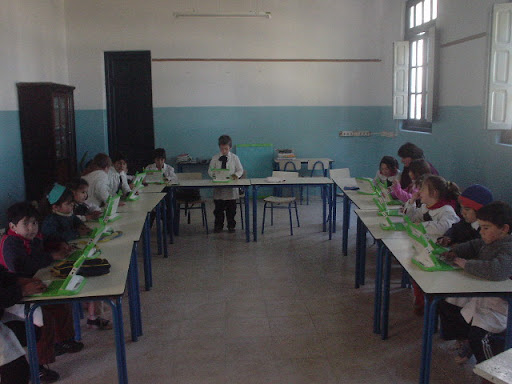
This slideshow is made with photos taken yesterday by Pedro "el paseante", during a trip to Villa Cardal. An enjoyable art!

a

Get the photos!

Here are the photos uploaded to Cardal's school blogs with XO laptops. In addition to the published ones, there are many pictures form "draft" posts of the blog that can be seen here.

No more words.

School's blog
Photos Show

4th form's blog

Photos

Show
5th form's blog Photos Show
6th form's blog Photos Show

Updated: Now we also have:
1st form's blog
2nd form's blog
3rd form's blog

The wallpaper of Cardal

Thanks to the contribution of Fernando Cormenzana, now we have an excellent wallpaper with pictures taken in Villa Cardal. Clicking the image you can see it in complete size for downloading.

Opening of bidding offers is delayed until next Thursday

As informed in the portal, we will have to wait one more week to know how the bidding proposals for the equipment of "Phase I" of the project are.

New Content - Kid Power!

(Translated by Alec McLure from "Nuevos contenidos: ¡los niños al poder!")

In the last few weeks I've been visiting Villa Cardal on a regular basis to provide support to school teachers (see pictures of a recent visit, here are some others taken by Fernando Cormenzana). The goal is to help them do new tasks with the laptops - tasks that sometimes require either some technical knowledge or English-language skills. English is still the main language both on the internet and on XO (just look at eToys).

Last week we worked with 4th and 5th graders to upload photos to a blog. You can see the first attempts at http://cardal-ceibal.blogspot.com/. Note that this is a first, experimental attempt. There was no time for any graphic design or to pick favorite pictures - some of the entries haven't even been reviewed yet by the teachers ( e.g., an entry that a student uploaded from home.). Anyhow, although there's not much to be seen yet, it gives us a glimpse of the potential of child-developed content.

This adds on to our other initiatives (such as email) that have slowly been growing in the student population- among other experiences, it has allowed them to contact Brazilian children who are having similar experiences.

In a world where Spanish-language content is increasingly consumed although not much produced (for example, Spanish is in ninth place in Wikipedia's article count) it's a good sign to have this new generation of content creators. All that's missing is to have teachers join in in the revolution.

Birth of a cow in Villa Cardal

This video was taken by a student of Fourth Year of the school of Villa Cardal, with his XO computer. It is about a complicated birth of a cow.


It is worth remembering that Villa Cardal is a locality of great farming activity (“capital of the milk river basin of Uruguay”). This work is part of a series of activities that we are making in the school relative to the work in the "tambo" (dairy farm).

Equipment Bid Deadline Extended by One Month

Upon request from participants in the official bidding process a one-month extension has been granted. This means that the official presentation and unsealing of bids will now take place on August 24th.

The option to grant justified bid extensions was specified in the original call for bids document.

Additionaly, a new call for bids for the provissioning of school servers has been issued. This call complements the former one, giving a chance for other suppliers to make their proposals for this "more standard" resource.

The Intel – OLPC Agreement - Information and Speculative Predictions

(Translated by Alec McLure from Información y futurología del acuerdo Intel - OLPC, published by Pablo Flores on 7/14/2007)

The announcement of the agreement reached by OLPC and Intel gives rise to much speculation as to how the OLPC project will continue and how it will impact Uruguay and other countries joining this initiative.

Let's begin by analyzing just what is in this agreement. There's not much official information, but what is clear is that Intel will join OLPC's board of directors. (The roster will now consist of representatives from AMD, Brightstart, Chi Lin, eBay, Google, Intel, Marvell, News Corporation, Nortel Networks, Quanta Computer, Red Hat, and SES Astra.)

Like all OLPC corporate associates, Intel will bring some capital when they join the project – this hasn't yet been detailed in public. This is what's known up to now.

Words from some of the lead players:

  • "Intel joins the OLPC board as a world leader in technology, helping reach the world's children. Collaboration with Intel means that the maximum number of laptops will reach children," said Nicholas Negroponte, founder of One Laptop per Child.
  • "This agreement will make computers get to children faster," said David Cavallo, Latin America Director of OLPC.
  • "Joining OLPC is a further example of our commitment to education over the last 20 years and our belief in the role of technology in bringing the opportunities of the 21st century to children around the world," said Paul Otellini, CEO of Intel.

The leads seem happy. What does this agreement imply? We still can't be clear on it. Ideally both parties would synergistically achieve better-quality equipment at a lower cost. This can take time, which doesn't mean that they would be able to reach agreements on time for immediate needs, such as Uruguay's Call for Bids.

As an example, this call for bids asks the bidder to be established in Uruguay, which would be a challenge for OLPC. In this sense, a joint proposal would make it easier to meet this requirement.

With what laptop? Surely it will be some version of the XO, since it already has better specs to meet the project's requirements, such as the wireless mesh, the camera, and the tablet PC format. OLPC is way behind on software, though, and Intel could provide an interesting and immediate boost, integrating its Skoool educational systems.

And the OS? A Windows/Sugar dual boot proposal would not surprise me – this would be an interesting option from an educational standpoint.

Another theme is cost. With the elimination of competition, countries are not well protected given the lack of options and negotiation possibilities. I hope that with Intel's injection of capital and new possibilities for economy of scale, OLPC may be able to meet its initial promise to sell the laptops at $100. It would be an excellent way to demonstrate their seriousness and be a key factor in purchase decisions in many other countries.

Following are other aspects of the vision of the future in the agreement pointed out by Luis Ramirez in his blog:

  • AMD – Intel's main competitor and the ones in charge of producing the AMD chip must be quite affected by this alliance. One speculation is that XO's first generation (planned to be available in the next few months) will have AMD's processor and that maybe the second generation (planned for production in 2008 and commercialization in 2009) will have some kind of Intel chip.
  • Intel could stop producing the Classmate PC (currently being sold in Chile and other countries) in exchange for providing its processors to OLPC beginning in 2008. Let's also recall that OLPC recently announced plans to develop commercial products in addition to the XO laptop. This apparently fits in to not only to the projects goal of eventual self-sufficiency, but also to be able to complement it with other OLPC-style servers and equipment.

Thoughts on the Bidding Process

(Translated by Alec McLure from Comentarios acerca del llamado a licitación 7/07/2007, published by Pablo Flores)

In a previous post I did some initial commentary on the bidding process for Phase I of the Ceibal Project. I'm going to provide a more detailed summary here, now that I've had the chance to read the bidding document in more detail.

First of all, one notices the enormous amount of work involved in considering a project of such complexity. This results in requiring projects proposals with a very wide scope. In this post, I'm only going to mention a few of the points that seem to me to embody the spirit of the call to bids, which doesn't mean that I'm not leaving many important aspects out.

Ceibal Project's Objectives
First, the bid document makes all the project's expected results very clear:

  • Provide internet connectivity to 100% of school-age children both in their schools and in their homes.
  • Put our country on the cutting edge as applies to the use of technology for the learning and formation process.
  • Close the technology gap in regards to access to information and knowledge.
  • Give access to culture, plurality, and opportunity without economic predetermination.
  • Put Uruguay in place as the first country in the world with internet coverage over 100% of its territory and in the highest percentage of homes.
Wow! A very ambitious project!


Proposal Requirements:
Three types of hardware must be included in the proposal: Notebooks, servers for the schools, and connectivity devices.

The Notebooks:
  • Explicitly must be portable, lighweight, and resistent.
  • Battery life must be 4 hours during "regular use"(navigation on a program that opens a new web page every 30 seconds). Currently I don't think that any of the candidates' prototypes meet this requirement.
  • Must have integrated WiFi.
  • The Operating System:
    • Must be included in the notebook's price
    • Takes into account its hard disk and memory usage
    • It must be able to use its applications in stand-alone mode (i.e., must not need to be constantly connected to the web). This helps to mitigate the intellecutal property risks I was mentioning in a previous post .
    • An integrated hardware security system is required which should deactivate the notebook if it's stolen.
  • It asks for applications which can function in a collaborative way among the notebooks connected to the web.
  • The camera, along with some other hardware and software components, are optional but mentioned as pluses in the proposal. By what I've seen in Cardal, the teachers get a lot out of the still and video cameras. I hope we don't lose that.
  • Although optional, it's considered a plus to have "open and modifiable" software.
  • An interesting detail is that they must have been made less than 120 days ago, thereby ensuring that if they make new models, they won't stick us with the leftover old ones. :)
Servers:
  • Install one or more for each school.
  • Minimum storage capacity of 80 Gb. Daily incremental backup.
  • Include web-content filtering software.
  • Software and updates up to 2010 included in the price.
  • Optionally, powerable by solar energy.
Connectivity requirements:
  • Requests wireless coverage for the homes in the schools towns.
  • Proposals must be developed taking into account three basic "model configurations" - schools with 150, 450, and 750 students.
  • The schools in Villa Cardal, San Jacinto, and Sarandí Grande are proposed as connectivity testing sites before the proposal's delivery date. Successful testing there adds positive points towards adjudication.
The company that wins the bid must be established or will need to establish itself in the country.

The bid proposal also requests bids for technician training and equipment support. The equipment must have a warranty.

If a bidder, for strategic reasons, would like to somehow subsidize their offer, this must be explicitly indicated and the sums involved must be divulged.

Adjudication
The technical proposal counts for 60% of the final score, the economic proposal for the remaining 40%. The bid document indicates a wide range of factors that affect the score. In any case, it keeps options for further bidding processes or direct negotiation with the bidders open if it turns out to be convenient.

Timelines
  • The bid refers to two phases: a first phase with 100,000 notebooks and a second phase (optional purchase) which adds on another 50,000. In any case, the bid asks for pricing on 5,000 notebooks, which opens the possibility of purchasing more from the winning bidder, if convenient.
  • There is a set of shipping dates: October 1st, 2007, January 1st, 2008, April 1st, 2008, July 1st, 2008, October 1st, 2008, January 1st, 2009, April 1st, 2009, July 1st, 2009, October 1st, 2009. LATU - through its project commissions will set how many notebooks and servers will be requested in each case.
  • It's not 100% clear when the first delivery will be, since both the proposal delivery date and the adjudication process can be delayed if it's considered convenient to do so.

Conclusions
  • Bidders are required to provide proposals on complete solutions that deliver notebooks, servers, and connectivity to different types of population.
  • LATU's flexibility to work in the private domain is used to advantage to encourage competition, thus obtaining a better price.
  • It's clear that whoever wins this bid is well-positioned to continue with the whole project (that's to be expected - it wouldn't make sense for half the equipment to be of one type and the other half of a different type - unless expected results are not obtained.)
  • Organizational tasks, educational proposals and a part of the techno-logistic tasks are reserved for the project's organization. For the rest of the tasks, my understanding is that expectations are that the winning bidder will become a participant in the project.

Uruguay's Florida department is next

(Translated from Se viene Florida, published by Pablo Flores on 7/05/2007.)

The next objective of the project is to expand to all of the department of Florida. This means giving computers to all its kids and teachers, as well as providing connectivity infrastructure in all its schools and in as many homes as possible.

I don't have the exact numbers now, but we are talking about more than 100 schools (many of them called "rural", with only one classroom and one teacher), about 500 teachers and 10,000 kids. The total population of Florida is close to 70,000, half of whom live in the capital city Florida, most of the rest live in smaller cities, and 12,000 live in rural areas.

Many things are going to be tried out for the first time (in Uruguay and in the world) when this expansion phase is finished. For the first time locations in a critical social context will be reached. Also, larger cities will be covered (Cardal has less than 2,000 inhabitants). The challenges are many.

From the educational point of view, a training meeting for the department's teachers is being organized for next week. Attending this event is voluntary, as it surely will be for all similar meetings. Given that many activities will be performed in the workshop modality, the openings are limited, but it is hoped that many will be interested in attending and the event will be repeated at different occasions.

This expansion is expected to be performed between August and September. For this, the bid will have had to have been adjudicated.

More information about Florida (in Spanish):

Call for bids for the phase I of the project, in English

As I mentioned before,the international call for bids for Phase I of the project has begun.

Now there is a version in english available. Access it here.

Institutional video of the project, now subtitled in english

Thanks to Alec McLure, now we have the first institutional video of the Ceibal Project subtitled in english. Enjoy!

It's started the bid for buying the first computers... and more

(Ver este artículo en español)

Yesterday it was published the sheet of the international bid for the purchase of the necessary equipment for Phase I of the Ceibal project. Its terms can be read in this pdf (in spanish).

Some items I hilight:
  • It's not only for buying laptops. It also asks for software, school servers, connectivity devices and a proposal for qualification, support and maintenance.
  • 3 configurations of schools (of 150, 450 and 750 students) are proposed, so that offers include laptops, servers, connectivity, etc. This is fundamental to analyze different technological options (for example connectivity with mesh network Vs. solely through Access points)
  • It looks for buying 100,000 computers, to be solicitd in different stages.
On the 27th of July the envelopes will get open…

A meeting with parents at Villa Cardal

(Translated from Reunión con padres en Villa Cardal, published by Pablo Flores on 6/03/07)

Last Friday we had a meeting at Villa Cardal with the parents and teachers of the kids that attend the school. Several of the project collaborators gathered in a classroom to inform advances in the project, but mostly to listen to opinions, comments, criticism... to have some feedback on how this community is experiencing the arrival of the laptops. From this meeting I compiled several phrases that I want to make public in this blog.

The parents

The meeting congregated a lot of parents, we didn't count them but I estimate they were over one hundred. The great majority of them didn't have a computer at home.

I was surprised to see how grateful this town is. With a lot of humility they told us their experience.

Some of the most touching phrases that were heard:

  • "My daughter's dream was to have a computer and I had never been able to buy one."
  • "The world has entered my home."
  • "It's incredible how much was advanced in these days, kids are not afraid."
This type of comment arised over and over from parents, that unanimously stressed the motivation and enthusiasm they saw in their kids.

Some of the comments were related to the impact of the laptop's arrival to their home:
  • "It demands more time from us, to show their achievements with the computer and to teach us."
  • "They don't want to skip class because they are afraid they would teach something new about the computer."
  • "It unites the family, they don't like to work alone."
  • "It increases communication in the family."
  • "He hasn't turned on the other computer anymore."
  • "They watch less TV."
They also talked about the way in which kids use the computer:
  • "First grade kids handle everything in a visual way. Although they don't know how to read, they surprise us with the easiness they handle it."
  • "I have 4 kids at school", ... "I see they have the same enthusiasm at all ages."
  • "The sister wants to help him, and he doesn't let her because he wants to achieve it by himself. Sometimes this brings fights."
  • "They have taken photos of the whole family and everything they see."
Some parents also made proposals, like elaborating a "basic manual for parents", or having the opportunity to attend courses and learn the contents loaded in the laptops.

The teachers

The teachers and the school director also told their experience. They are learning how to take advantage of the laptops to teach together with the kids and the project's team.
  • "We promoted helping the classmate, explaining what one knows..."
  • "Reading and orthography were incentivated enormously."
  • "Little kids that didn't stand out in the past surprised us with their command of the machine, they also teach their classmates."
  • "I had good experiences putting two kids working in the same machine, so they can discover together helping each other and there is not a big difference with the time it takes to each one of them to complete the activity."
  • "Some kids get distracted in class making other activities in the computer, so we take it away for one day as a punishment."
Complains and problems

The main aspect to solve in Cardal is the lack of Internet access from homes. Although several Access Points were installed in different places, it is still not easy to connect from most of the houses. The phrase "... and we are waiting for Internet" was repeated by most of the parents. Teachers also had some difficulties with Internet, because apparently not all the time there's good connectivity inside the school.

Apart from that, in the last few days we registered the first computer break-up; as a consequence of a brother's fight, during the struggle the screen broke. For some days the kid will be without a computer until we determine if it is possible to repair it.

Conclusions

In Cardal we are in an experimentation and learning process in which there are still many points to solve. The meeting was very moving and, most of all, we perceived the gratitude from a town that is motivated by a new opportunity in their hands.

I finish with a phrase from Sylvia González, who coordinated and led the meeting: "It is a project of equity, it is base on giving technology access to populations that wouldn't have it otherwise." "We are all part of this. It is not only a technologic nor pedagogic subject, but everyone together trying to build something better."

P.S.: I'm waiting for photos taken at the meeting by some teaching students. I'll upload them as soon as I get them.

TV-journal note about the evolution of the project - In english

In a previous post, I uploaded some videos of a uruguayan TV journal ("Subrayado"), reporting the evolution of the pilot project in Villa Cardal.
Now you can find an english translation of this videos thanks to the work of Alec McLure.

Enjoy! First segment, second segment, third segment.

Official project's website: www.ceibal.edu.uy


With the lemma "a space to innovate", yesterday was launched th official web portal of the Ceibal Project: http://ceibal.edu.uy. More information in this post in spanish.

TV-journal note about the evolution of the project

This note was made by the journalist from Channel 10 of Uruguay Pablo Silvera on May the 18th int the "Italy" School of Villa Cardal.
The first segment shows the impact of the project on the school and children.


In the second segment, the story of a family that lives in a "tambo" (I don't know how it is called in english, the place where cows are bred to produce milk). A uruguayan family as many others... except that they have 3 children at the school, so they get home with 3 laptops!


In the last segment there is the interview made to Sylvia González about technical aspects. The presenter starts saying "the Internet page of the Ceibal project receives 20,000 daily visits", referring to this blog :-) Somehow exagerated...


I also recommend, for seeing practical experiences of the laptops usage in brazilian schools, take a look at the videos in this post from olpcnews.

"Uruguay Could Become a Model for Low-Cost Laptop Programs"

As I commented in a previous post, Vinod Sreeharsha is an independent journalist who was in Villa Cardal making a coverage during the launching of the pilot project. Here is the complete article he wrote - which has additional information to the one published in the Miami Herald.

International echoes of the starting of the project


The launching of the pilot project in Cardal with OLPC laptops had international repercussion. Pictures of children, teachers and authorities appeared in pages from Uruguay, Brasil, Israel, United States, Germany, Italy, China and Japan, within others. The post "Villa Cardal, Center of worldwide attention", with its gallery of photos was linkd from more than 90 blogs worldwide an was at the top of digg for some hours, which took thousands of accesses to the blog from many places in the world.

In the map, points indicate places from where there were more than 30 accesses.

Within all notes made, I would like to emphasize the one from Vinod Sreeharsha, independent journalist who was in Uruguay those days to make a close coverage for Miami Herald. The article is very beautiful, it's good seeing with foreign eyes some of the experiences of those days.