Showing posts with label news. Show all posts

Questions to Negroponte

OLPC has changed its priorities drastically, with a very brief statement of its founder, Nicholas Negroponte, which did not clarify many key aspects of this change.

On this basis, in the OLPC-Sur list we produced a set of questions that have been sent to him, and we hope to have the answer soon. Here they go.

About the new priorities:

1. Development of generation 2.0

  • It appears that the OLPC development team will dedicate themselves to this, is it so?
  • What efforts will OLPC make to support the XO-1?
  • Will the XO-2 be developed as an important free software project as the XO-1 was?
  • For how long is the XO-1 going to be in production?
  • Is the production of XO-1s at risk if the sales stop? Do you have a plan to sustain the demand for XO-1s in this atmosphere of uncertainty?
  • Whats your timeframe for having the XO-2 in the market?
  • In what ways are you planning to involve the community in the development of the XO-2?

2. A no cost connectivity program
  • What technologies are you aiming at?
  • What will the first deployments be?
  • What role will the community have in this project?

3. A million digital books
  • How does this integrate into the ongoing OLPC project?
  • What places will be given priority for their distribution?
  • What technologies will be used for their implementation?
  • Have you considered having them be sound and music players as well?
  • What role will the community have in this?

4. Passing on the development of the Sugar Operating System to the community.
  • In what way will OLPC support the community in this transition?
  • What concrete plans do you have to help the deployment countries supported by the OLPC software developers who won't be there anymore?
  • Will OLPC open other options for software platforms in addition to Sugar?
  • What place will the community have inside OLPC?

About OLPC Latinoamérica
  • How this separation is gonna be handled? What this spin off mean?
  • Which communication will remain between OLPC and OLPC Latina?
  • Which it's gonna be the structure of the desicion making process in OLPC and OLPC Latina?
  • Which it's gonna be the OLPC's business model?
  • Is Latinoamerica included in the "Give Many" program?
Other questions
  • Have you thought how to keep improving and debugging the software of the already delivered XOs?
  • What would you say is the OLPC's essential mission? has it changed? Que policies is OLPC going to use to acomplish that mission?
  • How important is to give recognition and to strengthen the XO's community of free software developers to reach OLPC's vision?
  • Is there any chance that one of the OLPC's board member could come from the OLPC community?

Ciebal Search Engine

Originally published by Pablo Flores on Thu, Jul 10th, 2008
Translated by Paul D. Spradling

This search bar gathers information related to Ceibal Plan from over 50 websites. It's great for searching for educational material, technical support, news, historical material and more. I hope you find it useful.


To embed it on another website or blog just copy & paste the following HTML code:
<form action="http://www.google.com/cse" id="cse-search-box">
<div>
<input type="hidden" name="cx" value="006919666904599263899:v8q6iznlepq" />
<input type="hidden" name="ie" value="UTF-8" />
<input type="text" name="q" size="31" />
<input type="submit" name="sa" value="Buscar" />
</div>
</form>
<script type="text/javascript" src="http://www.google.com/coop/cse/brand?form=cse-search-box〈=es">
</script>

Book "Ceibal in the society of the 21st century" was published.

On June th 27th we launched the book “Ceibal in the society of the 21st century - References for parents and educators” (only in spanish, at the moment), of which I had the great pride of being compiler and coordinating the production.


As we say in the introduction:

CEIBAL Plan is a great bet of Uruguay for equity, democratization of knowledge and improving education. According to the schedule, in 2009 it will finish the delivery of portable personal computers to all primary schoolchildren and teachers in the country, while running a process of updating the education system to the reality of the times.
Children are receiving owned computers for use at school, and also in their homes, opening the possibility that its use gets shared within the family. In turn, through a huge technical effort that takes the country at the forefront in terms of connectivity, the CEIBAL Plan is carrying out internet access not only to schools but also households. This will offer to the entire community a new opportunity to learn basic computing, accessing information of interest, and engage in exchanges with other actors and agencies of society.
Within this framework, it becomes more important the effort that the country has been operating to provide services to citizens via the Internet, what is known as "electronic government". This book seeks to generate discussion about the new possibilities for the community and offer some elements for exploiting them.
(...)

The first chapter is an overview of the Plan, developed from the standpoint of the team that is responsible for defining its educational policies. This vision is complemented in Annex 2: "Educational Project".
Chapter 2 seeks to provide a historical perspective of the Plan, its origins, evolution and implications, mainly from the standpoint of social impact that is generating and that can be achieved in future.


The book was produced and printed with the support of UNESCO.

We tried to reach as much people as possible, offering different readings through photographies, illustrations, sockets, etc.


(come on dad, get the laptop that it doesn't byte)


You can download it online here (pdf, in spanish).
You can access more material about the book in www.ceibal.edu.uy/gobiernoelectronico.

Hope to have the chance to translate the material into English soon.

Rising Voices Article

Nice article written in Rising Voices blog, about some of the last activities we've been doing for developing for the XO: Blogging Since Infancy: Engaging the community to build new media applications for OLPC laptops.

Just as a clarification, I'm not "in charge of distributing One Laptop per Child (OLPC) XO laptops to the hundreds of thousands of Uruguayan child students", I'm just part of a team working on the technological and educative aspects of the project.

Thanks Rezwan!

Ceibal Jam! Let's develop for th XOs!

Translated by David Sasaki of Rising Voices in the article Ceibal Jam! An event for the XO. See post in spanish.


The time has arrived to make some new applications for XO laptops. Uruguay is in a privileged position, since our high density of XO laptops gives us a large user base who can use our software. To put it another way, Uruguayan programmers have the double benefit of being able to both provide practical solutions to meet the educational (and other) needs of our country and, at the same time, distribute their applications to the entire world.

To facilitate the exchange, with the support of LATU and the Faculty of Engineering, a gathering called Ceibal Jam! is being organized this weekend for developers interested in programming applications for the XO. Information is constantly being updated on the wiki, where you can register and participate.

The purpose of the meeting is to make initial contact between those interested in developing on the XO platform and to start working on some interesting applications. To do so, we are going to host some introductory talks and workshops, and then organize in small teams focused on specific development goals. In particular, there is an initiative to develop a system to facilitate the creation of blogs from the laptop, which would increase the number of blogs authored in schools throughout the country.

“Jam!” meetings take place throughout much of the first world and consist of gathering people with common interests to work intensively to create something together. Its origin comes from jazz groups, which conducted improvisational “Jam sessions,” usually after a concert. It is a new mdoel in our country, but we hope that is not the last meeting of this kind.

Be sure to attend!

The Value of Creativity

Originally published by Pablo Flores on Wed, Jan 23rd, 2008
Translated by Paul D. Spradling

Alberto Nieto, Executive Secretary to the National Agency of Investigation and Innovation (ANII), makes some very interesting declarations with respect to the rolls played by Plan Ceibal and the roll of teaching in our country, in an interview with the El Pais newspaper.

“(…) another very important value which we’ve lost is creativity; social creativity must be declared. And in that sense the present educational system in Uruguay, and in any country, has few possibilities of resolving it.

Why?

Because the educational system’s main function, whether we like it or not, is to teach to read, write, add and multiply. If in addition to that you promote creativity, the teacher has to be Mandrake [the magician]. We need to search for tools that will allow students to develop their creativity. The child learns, and simultaneously he’s thinking on his own, developing creativity, inventing things. This is fundamental for the country, we need kids that are accustomed to seeing the world with a creative and entrepreneurial vision. These values are not easy to stimulate through the current educational system. Looking for lateral exits, like Project Ceibal, seems very asserted.”
Nieto’s way of thinking puts the importance of parallel actions that can be realized over Plan Ceibal in evidence; they can act as innovative and creative catalyzers on the Uruguayan society. The Ceibal Plan has the great advantage of opening spaces of participation to institutions and people (while being completely inserted into the current elementary system), which if well used, can generate opportunities for the productive growth that the country needs.

He is later asked in what areas could we innovate in Uruguay.
“The priority today is in the sectors of agro-industrial chains, biotechnology and pharmaceuticals, alternate energy, technology in information and communication, touristic complex and natural resources and environment.”
We can think of innovative projects that take advantage of Plan Ceibal’s potential and favor these areas. For example, how about capacitating producers on the best seeds they can plant, the best work tools, give them fresh information on the market’s prices, provide them the opportunity of connecting between themselves to make common actions…? The possibilities are there, the conditions to make use of them are also there. An example is the recent agreement UNESCO made to perform a production that will teach people to take advantage of the possibilities in the use of the laptops to access electronic governmental benefits.

It’s all a matter of not saying with arms crossed, use imagination and go. It’s a lot more productive than waiting for the solutions to our problems to come from the outside.

The Government & Ceibal

Originally published by Pablo Flores on Thur, Dec 27th, 2007
Translated by Paul D. Spradling

The ministers’ council in Sarandí Grande today was marked by the presence of the Ceibal Plan. Every minister had his or her own XO. Beyond the symbolism and the different ways to view this form of the Government’s communication (that, by the way, surprised some friends from other countries who found how close our Government can be to the people incredible), it is a true demonstration of support to the Plan from the highest position of hierarchy.

These are the words of President Tabaré Vázquez regarding the Project:


• View the picture & video gallery of the ministry council and the inauguration of the MEC (Ministry of Education and Culture) center in Sarandí Grande (includes speech by Jorge Borvetto, Minister of Education and Culture)

• View the Presidency’s photo gallery of the ministry council

Ministry Council Open on Thursday: “Information and perspective on the development of Plan Ceibal”

Originally published by Pablo Flores on Wed, Dec 26th, 2007
Translated by Paul D. Spradling

In accordance with information from the Presidency’s Calendar for December 27th:

The Ministry Council will meet in Sarandi Grande, Florida, in a new rapprochement instance of the Government to the people. There, the Ministers will expose topics of interest and give information and perspective on the development of Plan Ceibal.
(…)
All Ministers will meet with the society’s institutions and organizations from 1:30pm to 4pm.
As informed in the same page, a MEC Center (Ministry of Education and Culture) will be inaugurated that same day in Sarandi Grande.

P.S.: It’s pure coincidence that last week’s activity with the University de la Republic was in the same town.

New support material from Florida’s IT teachers

Originally published by Pablo Flores on Mon, Dec 24th, 2007
Translated by Paul D. Spradling

Florida’s IT teachers have created their own blog where they are supporting the project: http://ceibalflorida.blogspot.com/

There you will find material, such as this presentation on how to manage files and use a pen drive:
[I will only translate previous posts, videos and slideshows upon request. Leave a comment or email me at spradling 'at' gmail.com]


The blog also has news and tracking, direct from where all the action takes place. Congratulations for the initiative!

Press: “OLPC creator arrives to Uruguay in March”

Originally Published by Pablo Flores on Mon, Dec 24th, 2007
Translated by Paul D. Spradling

OLPC creator arrives to Uruguay in March
Visit. Nicholas Negroponte will assist the Americas Innovation Forum

Nicholas Negroponte, the mythical academic from Massachusetts Institute of Technology’s (MIT) Media Lab and president of the OLPC foundation will come to Uruguay.

He is coming to give a conference for Americas Innovation Forum (AIF), which will be held from March 30th to April 2nd, in the Conrad hotel of Punta del Este.

Organized by the Uruguayan Government, through the National Agency of Investigation and Innovation (ANII), AIF is the follow-up event of the Americas Competitiveness Forum (ACF) that took place in Atlanta, GA, USA last June, hosted by the US Secretary of Commerce, Carlos Gutiérrez.

The Executive Secretary of ANII, Alberto Nieto, presented this forum as the opportunity to encourage the meeting of the players of innovation and as a tool of socioeconomic development in the region. For Industry Minister Jorge Lepra, AIF 2008 also has the main objective of positioning Uruguay as a regional reference in the area of technological development and innovation.

The forum, whose motto is “Promoting prosperity and development through innovation”, was designed as a meeting point for the business, academic and governmental references of the Americas. These people know the importance of innovation and the added value of knowledge as key factors for development.

The three main objectives are: innovation culture and strategies, public policies to promote and support innovation, as well as the value of knowledge in enhancing productivity.

GURU. Nicholas Negroponte has been thinking for the best way to put a computer in the hands of every child since the 70s, but it wasn’t until 2005 that he presented his proposal to achieve it: OLPC, One Laptop Per Child. It’s about a small computer intended for Third World Countries; easy to use, impact, dust and water proof, that doesn’t need electricity to recharge (it uses a small generator). [Note: The generator was not implemented into final design].

But it’s not as cheap as originally proposed. Two years ago, Negroponte assured that his laptop would cost U$S 100 and that its production would begin in 2006. But the reality is that the mass production of the laptop didn’t start until late 2007 and that Uruguay would pay U$S 199 for each of the 100,000 PCs initially ordered for their Ceibal Project, inspired in the OLPC.

The plan consists of giving each public school student a laptop at no cost. Its two main objectives are: the digital alphabetization of the new generation of Uruguayans and to improve the traditional process of education. This initiative is considered key by the government, who assigned important budgets to the project.

Project Ceibal began last May with a pilot experience in Villa Cardal, Florida. In this experience, 180 children and teachers of the Italia School received their own laptop.

In addition to leading the creation of the XO laptops that are used in the Ceibal Project, Negroponte was a pioneer in the field of computer-assisted design, and cofounded and directs MIT’s Media Laboratory. He is also author of the best seller “Being Digital”, translated to over 40 languages.

In the private sector, he’s a board member of Motorola Inc. and a partner in a venture capital company specialized in digital technologies for information and entertainment. His company has given start-up funding to over 40 companies, including Wired magazine.

Source: El Pais

View post on Negroponte's visit to Uruguay in 1997 (This links to the Spanish version of the blog. I would go crazy if I were to translate old posts every time a new one links back to it. I will however translate them upon request. Leave a comment or email me at spradling 'at' gmail.com)

Press: "Ceibal laptops now reach Flores and Colonia"

Originally published by Pablo Flores on Mon, Dec 24th, 2007
Translated by Paul D. Spradling

Ceibal laptops now reach Flores and Colonia
Distribution of computers will continue in February and March.

The first stage of the Ceibal Project has come to an end with the distribution of almost 7,000 laptops to about 100 schools in Florida. The distribution to the rest of the departments of the interior will begin in February, starting with Flores. LATU is already working on the electricity and connectivity requirements in this department, as well as in Colonia.

Daniel Benedetti, General Manager of Brightstar Uruguay S.A., the company that sells the computers, told El Pais that 7,500 laptops, of the initial batch of 55,000, have been received and assigned to the department of Florida. The remaining laptops will begin arriving on February 2nd and throughout March to continue this project whose aim is for every student to have a portable computer of their own.

Currently, more than 85% of children who assist a public school in Florida already have their laptop. LATU President Miguel Brechner explained to El Pais that the laptops where distributed to the schools with better connectivity. “It was a technical decision. The laptops must connect to the network at least once a month for security reasons, so we don’t want to distribute laptops if they won’t have access to the Internet. Brechner assured us that “everything will be covered for when classes begin in March”.

The person responsible for LATU said that work is being done to fulfill the distribution in Flores, and then in Colonia, while the remaining rural schools in Florida are incorporated. Brechner said “there’s always a peak per department that must be resolved later, and we don’t want to move on to another department until close to 85% of the children have been covered”.

The delays are due to difficulties in connectivity, which Antel is in charge of. The Commercial Sub-Manager, Osvaldo Novoa, explained that to the moment they only had difficulties with some rural schools that had no telephone service or electricity. He said that ANEP and UTE are fixing these problems.

Novoa told El Pais that they have advanced at a good pace, and that they’re even working ahead on the connectivity of rural schools in Flores, Colonia and Soriano to prepare them for the installation of the networks and WiFi nodes.

Nicholas Negroponte (father to the OLPC project) will visit some of the schools in March, when he will come to Uruguay to assist the Americas Innovation Forum and the OLPC board meeting.

Source: El Pais Digital

Video of activity in Sarandí Grande

Originally published by Pablo Flores on Sun, Dec 23rd, 2007
Translated by Paul D. Spradling


For those of who weren't there, this 45sec video gives you a taste of the activities that took place in Saradí Grande.


Excellent video from Fernando da Rosa. He also wrote an article about the activities.

This was last activity of the year. We hope to continue our work late-January, and give the project everything it deserves!

A Day of Activities in Sarandí Grande

Originally published by Pablo Flores on Thurs, Dec 20th, 2007
Translated by Paul D. Spradling

Yesterday we were in Sarandí Grande for the announced support session for parents and teachers that have received their laptops recently.

We were a group of seven: 3 engineering professors (Gabriel Gómez, Raquel Abella and myself), 1 psychology professor (Esther Angeriz), 1 Communication Sciences professor (Fernando da Rosa), Fernando Cormenzana, and Daniel Viñar who decided to come along since he's promoting a similar project in Bolivia.

In the morning we worked with the teachers. We were surprised to find that many rural schoolteachers have not received their laptops yet. They had already been given a basic course so we decided to give them a more in-depth look at the uses of graphics and the internet. We counted on some very valuable support material: Fernando da Rosa's Videos, which we were able to copy to the laptops so they could have them for future reference.

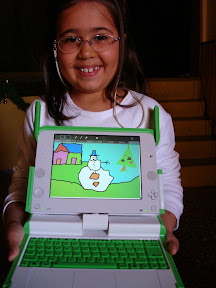
In the evening we received the parents, some of who brought their kids along. We started by introducing the project and giving some presentations on the theoretical use of the laptops. It was very interesting to see the parents listening attentively and the kids concentrating on tasks in the laptop. We then opened up for questions. It was amazing to see how some kids (like Valentina in the picture) have learned to use their laptops so quickly and how they put it in good use.

Being there was a great pleasure. The people were really grateful for the laptops and appreciated the help we went to provide. We arrived at the clear conclusion that there is great demand for more information, help documentation, support activities, etc. Surely, in part, it's because of the recent arrival of the XOs; they were not given the time to learn to use them sufficiently.

We hope to have a new activity in Florida before the end of the year.

More information:

Activities supporting Ceibal Project begin in Sarandí Grande

Originally published by Pablo Flores on December 14th, 2007. Translated by Paul D. Spradling.

Project "Flor de Ceibo", initiated in the Universidad de la Republica, has given rise to the collaboration between Plan Ceibal and LATU (Uruguay's Technological Laboratory). The project's general aim is to organize volunteer activities, counting with the participation of students and staff of the university. The project is in an embryonic state, but its aims are well defined:

The university will support Project Ceibal, accompanying and contributing, with the end of improving opportunity and equality in the access to the new technologies to all children in the country; generating a profound change in education.

It is expected that students and staff of the university will participate, contributing their experience to facilitate the students, teachers and parents first encounter with this new tool (the laptop).

By means of an activity of mass participation throughout the university, it is expected to contribute essential elements to the formation of the university's students. Key elements include: closer contact with the reality of the country, development of communication and expression skills, and the horizontal link with students and staff of other faculties or mayors.

We hope to generate links that will potentially give birth to projects of development, content or that will contribute national know-how. It is expected from this experience, that some students will maintain contact with the schools that they visited and that development projects with social utility will surface.

We aspire for a project of mass participation by students and staff of a variety of carriers, which will develop throughout the year 2008 in which Project Ceibal will spread throughout all rural areas of the country.

The modality of uniting, in mass, the university's students to the volunteer activities of Plan Ceibal will begin next year. Nevertheless, a preliminary activity in which only professors will participate, is already planned.

It will take place in the Sarandí Grande Theatre this following Wednesday, December 19th. The work schedule is the following:

10:00 to 10:30 Meet with teachers: Introduction.

10:30 to 12:30 Meet with teachers: Laptop utilization and email workshop. Q&A.

13:30 to 14:00 Meet with parents: Introduction.

14:00 to 16:00 Meet with parents: Laptop utilization and email workshop. Q&A.


The idea is to back off a little from exclusive school use, and to support the families so that they also take advantage of this powerful resource.

We expect everyone in the region. It is recommended to bring your own laptop.

Today begins the mass production of XO laptops

According to what Walter Bender said today in the inauguration of the OLPC Learning Workshop that is being held this week in Boston, right in this moment is starting the mass production of XO laptops. Initially, it is expected to have a production of 15.000 laptops per week, which will be accelerated afterwards.

It's Official - Ceibal Project Will Begin With XO Laptops and IBM Servers

, Monday, October 15, 2007

After the technical analysis period for the proposals presented in the call to bids and additional negotiation between Latu and the offering companies, the following have been adjudicated:

  • Laptops: XO from OLPC (represented in Uruguay by Brightstar)
  • School Servers: IBM servers (provided by INCO)
  • Connectivity: Declared as deserted
This adjudication went through a period during which the team from Positivo (the company that offered the Classmate PC) made comments on the technical evaluation (in which they came in just under 4 points lower). Latu officially responded to these comments, coming to the conclusion that they didn't apply. At the same time, Latu pointed out that in the proposal's total scoring (which included a 40 point economic component and a 60 point technical component) there was a large scoring difference in favor of Brightstar's OX offering; this offering came in at US$199 as opposed to Positivo's $243 (which was bundled within a package of service offerings.)

Some of the XO components, like the mesh network, integrated camera, and screen resolution had a strong effect in its favor. It's worth noting that all the components which the Education Commission had requested for the laptops were included in the call for bids' technical terms and in its scoring. It also appears to be a good thing that Villa Cardal's XO laptop experience can be built on.

As far as the servers go, INCO (Interamericana Computing) made a significant offer of IBM servers with 2 gigs of Ram, 2 x 120 gig hard drives, and installation service at the price of US$610. This was the winning bid.

As regards connectivity, the proposals presented were very expensive. This was most likely due to the challenging requirements for home coverage in the call for bids. Latu's technical team along with Antel, have been doing excellent work on this and have attained the experience to do it on their own if this should become necessary.

All this information will be confirmed at a press conference to be given by Latu in the next few days.

This adjudication corresponds to what was referred to as "Phase I", initially 100,000 laptops, so the possibility of strong competition for future roll-outs (as a matter of fact, a new and noisy global player has come into view: Asus EeePC)

2nd Latin American Meeting for Presentation of One-on-One Modality Projects

, Saturday, October 6, 2007

Translated by Alec McLure

A second regional project analysis meeting under the heading of "One Computer Per Child and Per Teacher" will be held on October 16-18, 2007 at Montevideo's Hotel Cottage.

Representatives are expected from Argentina, Brasil, Chile, Colombia, Costa Rica, Paraguay, Panama, and Peru, in addition to Uruguay (download Agenda (pdf in Spanish).

This meeting is strongly supported by the IDRC and its "IT and Communications Technology for Development in the Americas (ICT4D Americas)" program.

Linux.com: "Uruguay poised to make first governmental OLPC purchase"

Lisa Hoover of Linux.com has written an interesting article about the situation in Uruguay and the world refering to the OLPC project. She used different sources of information, included an e-mail inteview she made me days ago.

Here is a quote:

Negroponte says if Uruguay places an order for XO laptops, the project is ready to deliver. "Some machines would arrive as early as December 1," he says. Complete order fulfillment depends on a number of factors. "The exact rollout of laptops ... is driven as much by other orders and the need to keep overall manufacturing smooth -- flat or upward sloping -- not with peaks and troughs, to drive the price lower and lower."

According to Pablo Flores, a team member with the Ceibal Project, the organization overseeing the implementation of laptops in Uruguay's classrooms, there is a "logistics plan to distribute the laptops school by school" once delivery is taken. Flores says the Ceibal Project team is already preparing schools for the influx of laptops. "We are working very hard to integrate the computers into the educational system. We are training teachers and working in a collaborative environment to join together the contents and applications chosen by educators, as well as sharing educational experiences."
Read the complete article.

Press - Ceibal Plan Will Buy OLPC

Originally published by enrique_place , Thursday, October 04, 2007

Translated by Alec McLure

"Commision's Report leans towards US$199 laptop"

ALEJANDRO NOGUEIRA

The formal decision is not out yet, but Latu received the report from the committee adjudicating on the bid for 100,000 laptops for schools. Nicholas Negroponte's OX scored 56.84 points and the Intel Classmate 53.06.

Yesterday Latu looked at the two companies participating in one of the largest purchases envisioned by the State for one of this administrations' most ambitious educational plans. In addition to the original 100,000 computers in the bid, there's an option for another 50,000 and for hundreds of servers (which are in a separate call for bids).

Brightstar Uruguay presented the One Laptop Per Child (OLPC) program, which has the units designed by Negroponte's MIT group; Grupo Positive de Brasil were there with the Intel machines. Both of these units are made in China under their designer's specifications.

Timeline. The companies now have five days to present any objections to the process - this would delay any decisions by the government, which would rather get the decision made. the official intent is to begin distributing school laptops before the end of the yeard and to roll out to all schools in the country before the end of the current administration.

Brighstar began the process by offering their computer at US$205; Positivo at US$ 274 (in their open-source Linux offering) although this unit had more memory and functionality. Latu negotiated on price, and finally the OX went down to US$199 and Intel's unit to US$258.

Grupo Positivo's proposal, which included servers, connectivity, teacher training and educational portals, also had a proposal for use of Windows and tech support in Uruguay by the Sonda company.

Brightstar's offer only includes teacher training and tech support, in addition to an additional 1% supply of machines for replacement purposes due to wear and tear. In addition, this design allows for parts that can be replaced by the children themselves.

Both machines were additionally designed to be highly impact-, water-, and dust-resistant.

Negroponte's so called "green machine" (it's apple-green) doesn't have a hard disk and uses so called open-source (non-commercial) software. This machines book-sized prototype which weighs in at 1.5 kilos (3.3 lbs) was presented at the World Summit on the Information Society in Tunis at the end of 2005.

These laptops are the ones being used in a pilot program to bridge the digital gap which is being carried out in the Cardal school in the Flores department [in Uruguay]. [Translator's note - see editor's comment below - it's actually "Florida" department]

Negroponte originally announced a US$100 laptop but up to now hasn't achieved that price. His plan, which originally was focused on working with large populations in poor countries, will apparently have it's first concrete expression in Uruguay.

Uruguay's inclusion in this program was obtained after convincing him that it was easier to apply the project in a small country with a relatively sparse population.

Leader in Cell-Phone Logistics

Brightstar is the Motorola cell-phone distributor used by countries such as Movistar (Telefónica) and CTI Móvil (América Móvil), both in Uruguay and in other countries in Latin America. In Uruguay, it also distributes BlackBerries and Palm [Pilots] and LG-branded products. In the Ceibal Plan bid it offered the Intel-designed computers.

Brighstar Corporation is principally a distributor and provider for value-added services for the wireless telecommunication industry. It specializes in managing inventory, logistics, fulfillment, internet-based solutions, invidual packaging and post-sale support to the cell-phone industry. World-wide, it's the third-largest provider of this type of service. The company was founded in 1997 and now takes in about US$ 4 billion annually.

In July, Intel and OLPC announced a joint agreement to take the benefits of technology to countries in development by using the synergy between their programs. Intel joined the OLPC board in which several IT big-rollers participate. Among them are Google, AMD, Red Hat, News Corporation, and Bright Star itself.

Source: Diario El País

Editor's Note:

  • The bold-faces are mine, and not in the original article
  • Where it's stated that "in the Cardal school in the department of Flores" - "Flores" should be "Florida" (thanks to Gabriel Menini!)

Press: "Offers of U$S 205 and U$S 270 for laptops for Plan Ceibal"

(Translated from
Prensa: "Ofertas de U$S 205 y U$S 270 por laptops del Plan Ceibal"
, published by Enrique Placé on Sept. 14th, 2007.)

"LATU opened yesterday (Sept. 13th, 2007) the bidding offers for Plan Ceibal's computers. Brighstar offered laptops for U$S 205 and Grupo Positivo from Brazil offered laptops between US$ 270 and U$S 300 depending on the type of machine.

The special technical committee of Uruguay's Technological Laboratory (LATU) and the National Administration of Public Education (ANEP) finished the studies of the technical offers from both companies and yesterday noon opened the economic offers. The person in charge of the bidding, former national director of industry, Miguel Mariatti, said to El País that the information about the offers will be made public after being evaluated at the LATU's board, so he declined to give details at this time.

However, from sources related to this bidding El País learned that Brighstar Uruguay SA concentrated its proposal on terminals XO for kids, with 256Mb of memory, running open software (Linux), while Positivo offered computers with 256 Mb of memory also with Linux, and 512 Mb of memory with Windows platform from Microsoft. This company made a much broader proposal that included servers, connectivity, contents, network support, training for teachers and students, and availability of educational portals.".

Complete article at: Diaro El País (in Spanish).