Showing posts with label follow-up. Show all posts

Ciebal Search Engine

Originally published by Pablo Flores on Thu, Jul 10th, 2008
Translated by Paul D. Spradling

This search bar gathers information related to Ceibal Plan from over 50 websites. It's great for searching for educational material, technical support, news, historical material and more. I hope you find it useful.


To embed it on another website or blog just copy & paste the following HTML code:
<form action="http://www.google.com/cse" id="cse-search-box">
<div>
<input type="hidden" name="cx" value="006919666904599263899:v8q6iznlepq" />
<input type="hidden" name="ie" value="UTF-8" />
<input type="text" name="q" size="31" />
<input type="submit" name="sa" value="Buscar" />
</div>
</form>
<script type="text/javascript" src="http://www.google.com/coop/cse/brand?form=cse-search-box〈=es">
</script>

Laptops in the most disadvantaged areas of Uruguay

Translated by David Sasaki of Rising Voices. See post in spanish.

If we look at how the next phases of expansion of Plan Ceibal (OLPC in Uruguay), it is apparent that we are about to face some new challenges. The arrival of the plan to the capital, Montevideo, next year will bring a new unprecedented dimension to the project which involves the most marginalized communities in the country. For the first time, the poorest sectors will have a tool in their hands to connect to the information society. The children will bring the computers to their homes, the family will access the internet, and a new segment of the population will be online.

For the first time, those with little voice will have a medium of communication with which to describe their experiences, dreams, and needs from their own perspective, unlike the traditional means of researchers from other sectors of society speaking for them. Blogs, videos and e-mails are just some examples of ways in which this sector of society will be able to express themselves more strongly than ever before in order to show their culture, their way of thinking, their reality.

The same tool will be in the hands of both rich and poor in the country. Children, senior citizens, and the whole spectrum of society will be able to exchange mails, chats and favorite sites, in a Facebook-like manner.

Like never before, the most marginalized communities will have a powerful tool to make transactions and queries with public institutions. They may claim their rights from the government. If they are given the support, they may also use it for training, acquiring positions, and working remotely.

There will also be new means with which to communicate, to convey information of interest, culture, and new forms of entertainment.

Bringing technology to the most excluded classes is already starting in the provinces of Uruguay. Salto, the largest city in Uruguay after Montevideo, is one example. A belt of marginalized communities surround this city, which is currently being flooded by XO laptops in the hands of its children.

CF311517-B058-428F-9D20-D68B427FC095.jpg
Residents of Salto also want to make themselves heard.

There is a new form of communication, which brings us enormous challenges. We could think of it as something dangerous. We could see it as a new opportunity. But we must address the issue seriously, because the parameters which govern public opinion could change. Ceibal is giving growth to the internet for children … and now for the poor. It is an opportunity for social inclusion that, without the attention it thoroughly deserves, could become a new circumstance of exclusion.

Interview with El Espectador

Originally Published by Pablo Flores on Fri, Jan 18th, 2008
Translated by Paul D. Spradling

I [Pablo Flores] was interviewed yesterday on El Espectador radio by Diego Zaz and Marcela Moretti for the Asuntos Pendientes (Pending Subjects) show. Being the good, integrated in the information society people that they are, they uploaded it to the Internet as soon as it went on air. So for those interested that weren’t listening to the radio at the indicated moment, you can listen to is here (if you have Real Player):


Access the radio’s webpage with the interview

New support material from Florida’s IT teachers

Originally published by Pablo Flores on Mon, Dec 24th, 2007
Translated by Paul D. Spradling

Florida’s IT teachers have created their own blog where they are supporting the project: http://ceibalflorida.blogspot.com/

There you will find material, such as this presentation on how to manage files and use a pen drive:
[I will only translate previous posts, videos and slideshows upon request. Leave a comment or email me at spradling 'at' gmail.com]


The blog also has news and tracking, direct from where all the action takes place. Congratulations for the initiative!

Video of activity in Sarandí Grande

Originally published by Pablo Flores on Sun, Dec 23rd, 2007
Translated by Paul D. Spradling


For those of who weren't there, this 45sec video gives you a taste of the activities that took place in Saradí Grande.


Excellent video from Fernando da Rosa. He also wrote an article about the activities.

This was last activity of the year. We hope to continue our work late-January, and give the project everything it deserves!

A Day of Activities in Sarandí Grande

Originally published by Pablo Flores on Thurs, Dec 20th, 2007
Translated by Paul D. Spradling

Yesterday we were in Sarandí Grande for the announced support session for parents and teachers that have received their laptops recently.

We were a group of seven: 3 engineering professors (Gabriel Gómez, Raquel Abella and myself), 1 psychology professor (Esther Angeriz), 1 Communication Sciences professor (Fernando da Rosa), Fernando Cormenzana, and Daniel Viñar who decided to come along since he's promoting a similar project in Bolivia.

In the morning we worked with the teachers. We were surprised to find that many rural schoolteachers have not received their laptops yet. They had already been given a basic course so we decided to give them a more in-depth look at the uses of graphics and the internet. We counted on some very valuable support material: Fernando da Rosa's Videos, which we were able to copy to the laptops so they could have them for future reference.

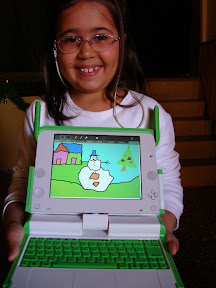
In the evening we received the parents, some of who brought their kids along. We started by introducing the project and giving some presentations on the theoretical use of the laptops. It was very interesting to see the parents listening attentively and the kids concentrating on tasks in the laptop. We then opened up for questions. It was amazing to see how some kids (like Valentina in the picture) have learned to use their laptops so quickly and how they put it in good use.

Being there was a great pleasure. The people were really grateful for the laptops and appreciated the help we went to provide. We arrived at the clear conclusion that there is great demand for more information, help documentation, support activities, etc. Surely, in part, it's because of the recent arrival of the XOs; they were not given the time to learn to use them sufficiently.

We hope to have a new activity in Florida before the end of the year.

More information:

A day in Villa Cardal

This slideshow is made with photos taken yesterday by Pedro "el paseante", during a trip to Villa Cardal. An enjoyable art!

a

Get the photos!

Here are the photos uploaded to Cardal's school blogs with XO laptops. In addition to the published ones, there are many pictures form "draft" posts of the blog that can be seen here.

No more words.

School's blog
Photos Show

4th form's blog

Photos

Show
5th form's blog Photos Show
6th form's blog Photos Show

Updated: Now we also have:
1st form's blog
2nd form's blog
3rd form's blog

New Content - Kid Power!

(Translated by Alec McLure from "Nuevos contenidos: ¡los niños al poder!")

In the last few weeks I've been visiting Villa Cardal on a regular basis to provide support to school teachers (see pictures of a recent visit, here are some others taken by Fernando Cormenzana). The goal is to help them do new tasks with the laptops - tasks that sometimes require either some technical knowledge or English-language skills. English is still the main language both on the internet and on XO (just look at eToys).

Last week we worked with 4th and 5th graders to upload photos to a blog. You can see the first attempts at http://cardal-ceibal.blogspot.com/. Note that this is a first, experimental attempt. There was no time for any graphic design or to pick favorite pictures - some of the entries haven't even been reviewed yet by the teachers ( e.g., an entry that a student uploaded from home.). Anyhow, although there's not much to be seen yet, it gives us a glimpse of the potential of child-developed content.

This adds on to our other initiatives (such as email) that have slowly been growing in the student population- among other experiences, it has allowed them to contact Brazilian children who are having similar experiences.

In a world where Spanish-language content is increasingly consumed although not much produced (for example, Spanish is in ninth place in Wikipedia's article count) it's a good sign to have this new generation of content creators. All that's missing is to have teachers join in in the revolution.

Birth of a cow in Villa Cardal

This video was taken by a student of Fourth Year of the school of Villa Cardal, with his XO computer. It is about a complicated birth of a cow.


It is worth remembering that Villa Cardal is a locality of great farming activity (“capital of the milk river basin of Uruguay”). This work is part of a series of activities that we are making in the school relative to the work in the "tambo" (dairy farm).

A meeting with parents at Villa Cardal

(Translated from Reunión con padres en Villa Cardal, published by Pablo Flores on 6/03/07)

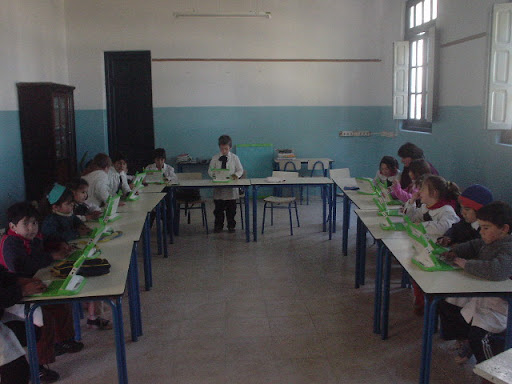
Last Friday we had a meeting at Villa Cardal with the parents and teachers of the kids that attend the school. Several of the project collaborators gathered in a classroom to inform advances in the project, but mostly to listen to opinions, comments, criticism... to have some feedback on how this community is experiencing the arrival of the laptops. From this meeting I compiled several phrases that I want to make public in this blog.

The parents

The meeting congregated a lot of parents, we didn't count them but I estimate they were over one hundred. The great majority of them didn't have a computer at home.

I was surprised to see how grateful this town is. With a lot of humility they told us their experience.

Some of the most touching phrases that were heard:

  • "My daughter's dream was to have a computer and I had never been able to buy one."
  • "The world has entered my home."
  • "It's incredible how much was advanced in these days, kids are not afraid."
This type of comment arised over and over from parents, that unanimously stressed the motivation and enthusiasm they saw in their kids.

Some of the comments were related to the impact of the laptop's arrival to their home:
  • "It demands more time from us, to show their achievements with the computer and to teach us."
  • "They don't want to skip class because they are afraid they would teach something new about the computer."
  • "It unites the family, they don't like to work alone."
  • "It increases communication in the family."
  • "He hasn't turned on the other computer anymore."
  • "They watch less TV."
They also talked about the way in which kids use the computer:
  • "First grade kids handle everything in a visual way. Although they don't know how to read, they surprise us with the easiness they handle it."
  • "I have 4 kids at school", ... "I see they have the same enthusiasm at all ages."
  • "The sister wants to help him, and he doesn't let her because he wants to achieve it by himself. Sometimes this brings fights."
  • "They have taken photos of the whole family and everything they see."
Some parents also made proposals, like elaborating a "basic manual for parents", or having the opportunity to attend courses and learn the contents loaded in the laptops.

The teachers

The teachers and the school director also told their experience. They are learning how to take advantage of the laptops to teach together with the kids and the project's team.
  • "We promoted helping the classmate, explaining what one knows..."
  • "Reading and orthography were incentivated enormously."
  • "Little kids that didn't stand out in the past surprised us with their command of the machine, they also teach their classmates."
  • "I had good experiences putting two kids working in the same machine, so they can discover together helping each other and there is not a big difference with the time it takes to each one of them to complete the activity."
  • "Some kids get distracted in class making other activities in the computer, so we take it away for one day as a punishment."
Complains and problems

The main aspect to solve in Cardal is the lack of Internet access from homes. Although several Access Points were installed in different places, it is still not easy to connect from most of the houses. The phrase "... and we are waiting for Internet" was repeated by most of the parents. Teachers also had some difficulties with Internet, because apparently not all the time there's good connectivity inside the school.

Apart from that, in the last few days we registered the first computer break-up; as a consequence of a brother's fight, during the struggle the screen broke. For some days the kid will be without a computer until we determine if it is possible to repair it.

Conclusions

In Cardal we are in an experimentation and learning process in which there are still many points to solve. The meeting was very moving and, most of all, we perceived the gratitude from a town that is motivated by a new opportunity in their hands.

I finish with a phrase from Sylvia González, who coordinated and led the meeting: "It is a project of equity, it is base on giving technology access to populations that wouldn't have it otherwise." "We are all part of this. It is not only a technologic nor pedagogic subject, but everyone together trying to build something better."

P.S.: I'm waiting for photos taken at the meeting by some teaching students. I'll upload them as soon as I get them.

TV-journal note about the evolution of the project - In english

In a previous post, I uploaded some videos of a uruguayan TV journal ("Subrayado"), reporting the evolution of the pilot project in Villa Cardal.
Now you can find an english translation of this videos thanks to the work of Alec McLure.

Enjoy! First segment, second segment, third segment.

TV-journal note about the evolution of the project

This note was made by the journalist from Channel 10 of Uruguay Pablo Silvera on May the 18th int the "Italy" School of Villa Cardal.
The first segment shows the impact of the project on the school and children.


In the second segment, the story of a family that lives in a "tambo" (I don't know how it is called in english, the place where cows are bred to produce milk). A uruguayan family as many others... except that they have 3 children at the school, so they get home with 3 laptops!


In the last segment there is the interview made to Sylvia González about technical aspects. The presenter starts saying "the Internet page of the Ceibal project receives 20,000 daily visits", referring to this blog :-) Somehow exagerated...


I also recommend, for seeing practical experiences of the laptops usage in brazilian schools, take a look at the videos in this post from olpcnews.