Happy 2008!

Originally published by Pablo Flores on Fri, Dec 28th, 2007
Translated by Paul D. Spradling

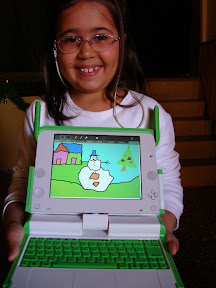
I say goodbye to the blog until mid-January and leave you with this greeting, made by Fernando da Rosa, that shows some of what’s beneath an XO.


It is now time to disconnect!

[I will only translate previous posts, videos and slideshows upon request. Leave a comment or email me at spradling 'at' gmail.com]

Usage Manuals for the XO

Originally published by Pablo Flores on Thurs, Dec 27th, 2007
Translated by Paul D. Spradling
Fernando Cormenzana has uploaded some support material on the usage of the XO to his blog:

• The XO’s JORNAL
• Introduction to SQUEK and E-TOYS
• OLPC Manual – SUGAR
• Zoom Metaphor
• Music & Sound on the XO

The material is based on some translated material on the OLPC’s wiki. Thanks for the contribution Fernando!

The Government & Ceibal

Originally published by Pablo Flores on Thur, Dec 27th, 2007
Translated by Paul D. Spradling

The ministers’ council in Sarandí Grande today was marked by the presence of the Ceibal Plan. Every minister had his or her own XO. Beyond the symbolism and the different ways to view this form of the Government’s communication (that, by the way, surprised some friends from other countries who found how close our Government can be to the people incredible), it is a true demonstration of support to the Plan from the highest position of hierarchy.

These are the words of President Tabaré Vázquez regarding the Project:


• View the picture & video gallery of the ministry council and the inauguration of the MEC (Ministry of Education and Culture) center in Sarandí Grande (includes speech by Jorge Borvetto, Minister of Education and Culture)

• View the Presidency’s photo gallery of the ministry council

Handing Out Plan Ceibal’s Laptops

Originally published by Pablo Flores on Thurs, Dec 27th, 2007
Translated by Paul D. Spradling

This article was written by Gustavo Ochoa, a volunteer who participated in the handing out of laptops a few weeks ago. It’s worth it!


Today is a time of renovation. Changes that are hard for us to start making. Because the same thing is happening to us with Varela, José Pedro, than with Varela, Obdulio.

The myths of Maracaná and the public school load us with obligations to the past and obstruct our view and ability to take action on what is ahead.

However, if we don’t close our eyes and put faith in the construction of a new vision, we are presented with opportunities that can show us part of the way.

Because with no vision there is confusion. And today we are lacking a slogan for education in which we can believe in, and bet our effort and will on.

Plan Ceibal is, without a doubt, one of these opportunities.

But you have to live the Plan Ceibal to understand it. It’s not possible to discuss if it’s OK, or if it’s opportune, or if a previous pedagogic project is required, or if it’s previously required to do this or that.

To understand Plan Ceibal, there is nothing better then to pass a day handing out laptops in the rural schools of the interior.

The doubts vanish after participating in this experience.

The Ceibal Plan is not an educational plan; it’s a plan of equity. The Varelian Reform was, among other things, also a plan of equity.

“All Uruguayans have the right to posses the tools that allow them to read books and access the ideas in them; and to carve themselves a better future with this access”, said Elbio Fernández.
“All Uruguayans have the right to posses the tools that allow them to access the global information highway and the ideas that circulate through it; and to carve themselves a better future with this access”, say those who impulse the Plan Ceibal.

There are many analogies that make me think that we’re upon a historical moment similar to that of the late 19th century. We are upon one of those moments that you can’t let pass.

We haven’t had, in the last 130 years, an opportunity to participate in a change so important for education as the one we’re developing today. Although many don’t see it yet.

That is why I decided to incorporate myself in the group of volunteers that went to hand out computers in the department of Florida. I leave you with my experience:

I arrived to LATU (Uruguay’s Technological Laboratory) before 8:00am on the cool morning of last Thursday. I asked the doorman where the volunteers met; he pointed to front of the Ingenious building, the area where innovative companies incubate. There were about half a dozen, half awake, high school kids (probably juniors and seniors) waiting there.
I introduced myself and found out that most of them where from High School #10, there were also a few from HS#15.

There was also a veteran, like myself; an engineer that was with the Open Source Center. Fernanda, a literature teacher and militancy partner from around 1983, arrived a while later. Pedro, a student, and Gabriela, a recent Telecommunications graduate, arrived later; they were both contracted by the Plan Ceibal to coordinate and supervise the handing out of the laptops
with the volunteers.

“Today we’ve got Chamizo, the rural area of Chamizo and Fray Marcos”, said Gabriela once inside the vans and on our way, “We’ll split up between the rural schools of the area and the schools in the towns I mentioned. We’ll form 3 teams in charge of you guys who are the adults.”
Some of the kids where already repeating the experience.

“This is the third time I come. I like anything that’s volunteer”, commented Leticia, a pretty, 17 year old brunette and a Senior in HS#10.

Ricardo, also from HS#10 and volunteering for a second time, was a real reference. You could see the capacity of organization and the seriousness with which these kids took the work.
The morning was clear and warm when we got to Fray Marcos, very pleasent.

School #45 was the town’s main building. Important in its two floors, but humble nonetheless. The park was across the street, with Artigas’ bust, a shady spot, calm, beautiful.

The post office vans were parked in the shade, waiting with precise logistic, with the precious cargo of computers that came directly from the port. And behind the gates were the looks of hundreds of kid’s little eyes.

And Mirta Mendieta, the Principal, who came out to receive us with a smile. “We’ve been waiting for you, the kids are very anxious.”

Gabriela goes through the formalities and signs the receipts with the Principal and the Post Officers, who had already unloaded the boxes. She took the other two teams and the necessary computers and left Ricardo, Francisco, Florencia, Stefanía and the veteran who’s speaking to you, to cover school #45. The school has almost 400 students, distributed in two classes per grade, from 1st to 5th grade, and one 6th grade class; a total of 11 classes plus the 2 ‘initial education’ classes.

We advanced through the halls of a well-lit and ventilated school; but you could see the effects of time and the difficulties in maintenance. Two beautiful and large classrooms in the 2nd floor were empty. “We weren’t able to use them this year and had to squeeze the 4th years into a deposit with no ventilation. When it rains, being in those classrooms it’s like standing outside. The isolation is very old, made in base of asphalt and fiberglass that are now expired. There is also no electricity on the second floor.”

Mirta told us about her worries and hopes as Principal. “We’re working on the roof, I’m showing it to Florit today so he can lend me a hand.” Héctor Florit arrived in a different vehicle than ours; he participated in the day’s activity, integrating with the handout and having lunch with the volunteer team.

We began with 2A. The classroom’s door was shut; it had no windows. When it opened, forty eyes looked at us and smiled. “Do you know what we’re here for today?” we asked as we entered. They respond in unison, “yesssssss!!!! To bring the computers."

We organized the handout and asked for a round of applause for the first little girl who received her laptop. They all clapped as each of them came to the front at our call. The calling reminded me of my childhood, of the roll-call in my class; I called them as my memory told me to: first the two surnames, pause, then the two first names in rapid succession.

The kids looked at the computer, the manual, the power brick, and waited for the others. But their anxiety to start opening, touching and looking beat them; clusters formed around each computer, where everyone observed over the owner's shoulders.

We weren’t done handing them out, and already some computers were already on, they had entered their access codes, and lauched the diverse applications.

“How many of you have computers in your homes?” The count of hands did not surpass 5 or 6, in the class of 30. The volunteers from HS#10 spread out across the tables and began explaining the basics; most of all, they were responding to individual questions.

But the cellular reproduction began immediately; unstoppable, spontaneous and geometric.

By using the old method of observing those who know, in less then 10 minutes they all had started their computers and found their favorite program.

An interesting observation: the games were not the first and most visited programs.

The most solicited, the question we heard the most was: “Mister, mister, how do I put music on?”
The second: “Mister, mister, can you teach me how to take pictures?”
The third: “Where are the games?” And the forth: “what do I have to do to write?”

But please, pause the reading for a moment and imagine the surroundings and the atmosphere: the questions came 40 at a time. They were directed at each of the team members, and also of course to the teacher, who with caution and aware of her own doubts and insecurities regarding the technology, always had an answer for the kids; even if it was immediately followed by a look of despair towards us.

They grabbed your arm, spoke one over the other and repeated the same question every minute.

Then we began: “Who was a able to take pictures?” A few answered, “me, me”, followed by my instructions: “OK, you teach him, and you teach her over there, who are asking for help on that which you know how to do.”

Fernanda looks at them and asks us if this experience was useful to for us to value the work of teachers.

None of the kids noticed when the team left to handout the rest of the laptops in the other classrooms.

“The thing is, after you give them the laptop, you seize to exist”, told me Pedro Arzuaga, an engineer who had already participated before.

We repeated the same with the other classes, with the same looks, the same laughs, the same shouts, the same applause, the same anxiety to have, to touch, to learn, to play.

“It’s the first time the kids cheer because recess is over” said the Pincipal at lunch.

Luis Garibaldi arrived in the afternoon and, doing as Florit, integrated in the handouts and participated in the explanations on the use of the machines to the kids. They both took a look at the situation and saw that it was far from being caos; the teachers and students rapidly took the tool into their hands and started establishing usage patterns.

Finally, we gave the computers to the “initial education” teachers and to Mirta. The work was done by 5 o’clock in the afternoon.

All the kids formed a line in the yard, as they do everyday, but today they had a special smile. They all carried their green carrying-case in their hands, and not in their backpacks. They all wanted to show it off, to their dad who waited outside, to their brothers, who knows.
A girl on her bike carried it in the shopping basket.

And like this technology integrated into Fray Marcos’ life today. Every kid now begins a new path, similar to the one the kids from Cardenal have already gone through. Surprising the world by uploading, with rural candor, the birth of a calf or the slaughter and fabrication of sausages to YouTube. They will be seen by hundreds of people around the world who have never been out of their city.

Because if there were doubts on the possibility of creating content by the mere handout of these computers, these doubts have now seized to exist. The children themselves will surprise as photographers, as journalists, as investigators. And they will communicate with the world without asking for anyone’s permission.

Ministry Council Open on Thursday: “Information and perspective on the development of Plan Ceibal”

Originally published by Pablo Flores on Wed, Dec 26th, 2007
Translated by Paul D. Spradling

In accordance with information from the Presidency’s Calendar for December 27th:

The Ministry Council will meet in Sarandi Grande, Florida, in a new rapprochement instance of the Government to the people. There, the Ministers will expose topics of interest and give information and perspective on the development of Plan Ceibal.
(…)
All Ministers will meet with the society’s institutions and organizations from 1:30pm to 4pm.
As informed in the same page, a MEC Center (Ministry of Education and Culture) will be inaugurated that same day in Sarandi Grande.

P.S.: It’s pure coincidence that last week’s activity with the University de la Republic was in the same town.

Reflections on the Future

Originally published by Pablo Flores on Mon, Dec 24th, 2007
Translated by Paul D. Spradling

New year's around the corner, a time of balances and reflection.

I enjoyed these videos; it’s good to take a break from the routine and think about the future a bit.


Merry Christmas to all!

New support material from Florida’s IT teachers

Originally published by Pablo Flores on Mon, Dec 24th, 2007
Translated by Paul D. Spradling

Florida’s IT teachers have created their own blog where they are supporting the project: http://ceibalflorida.blogspot.com/

There you will find material, such as this presentation on how to manage files and use a pen drive:
[I will only translate previous posts, videos and slideshows upon request. Leave a comment or email me at spradling 'at' gmail.com]


The blog also has news and tracking, direct from where all the action takes place. Congratulations for the initiative!

Press: “OLPC creator arrives to Uruguay in March”

Originally Published by Pablo Flores on Mon, Dec 24th, 2007
Translated by Paul D. Spradling

OLPC creator arrives to Uruguay in March
Visit. Nicholas Negroponte will assist the Americas Innovation Forum

Nicholas Negroponte, the mythical academic from Massachusetts Institute of Technology’s (MIT) Media Lab and president of the OLPC foundation will come to Uruguay.

He is coming to give a conference for Americas Innovation Forum (AIF), which will be held from March 30th to April 2nd, in the Conrad hotel of Punta del Este.

Organized by the Uruguayan Government, through the National Agency of Investigation and Innovation (ANII), AIF is the follow-up event of the Americas Competitiveness Forum (ACF) that took place in Atlanta, GA, USA last June, hosted by the US Secretary of Commerce, Carlos Gutiérrez.

The Executive Secretary of ANII, Alberto Nieto, presented this forum as the opportunity to encourage the meeting of the players of innovation and as a tool of socioeconomic development in the region. For Industry Minister Jorge Lepra, AIF 2008 also has the main objective of positioning Uruguay as a regional reference in the area of technological development and innovation.

The forum, whose motto is “Promoting prosperity and development through innovation”, was designed as a meeting point for the business, academic and governmental references of the Americas. These people know the importance of innovation and the added value of knowledge as key factors for development.

The three main objectives are: innovation culture and strategies, public policies to promote and support innovation, as well as the value of knowledge in enhancing productivity.

GURU. Nicholas Negroponte has been thinking for the best way to put a computer in the hands of every child since the 70s, but it wasn’t until 2005 that he presented his proposal to achieve it: OLPC, One Laptop Per Child. It’s about a small computer intended for Third World Countries; easy to use, impact, dust and water proof, that doesn’t need electricity to recharge (it uses a small generator). [Note: The generator was not implemented into final design].

But it’s not as cheap as originally proposed. Two years ago, Negroponte assured that his laptop would cost U$S 100 and that its production would begin in 2006. But the reality is that the mass production of the laptop didn’t start until late 2007 and that Uruguay would pay U$S 199 for each of the 100,000 PCs initially ordered for their Ceibal Project, inspired in the OLPC.

The plan consists of giving each public school student a laptop at no cost. Its two main objectives are: the digital alphabetization of the new generation of Uruguayans and to improve the traditional process of education. This initiative is considered key by the government, who assigned important budgets to the project.

Project Ceibal began last May with a pilot experience in Villa Cardal, Florida. In this experience, 180 children and teachers of the Italia School received their own laptop.

In addition to leading the creation of the XO laptops that are used in the Ceibal Project, Negroponte was a pioneer in the field of computer-assisted design, and cofounded and directs MIT’s Media Laboratory. He is also author of the best seller “Being Digital”, translated to over 40 languages.

In the private sector, he’s a board member of Motorola Inc. and a partner in a venture capital company specialized in digital technologies for information and entertainment. His company has given start-up funding to over 40 companies, including Wired magazine.

Source: El Pais

View post on Negroponte's visit to Uruguay in 1997 (This links to the Spanish version of the blog. I would go crazy if I were to translate old posts every time a new one links back to it. I will however translate them upon request. Leave a comment or email me at spradling 'at' gmail.com)

Press: "Ceibal laptops now reach Flores and Colonia"

Originally published by Pablo Flores on Mon, Dec 24th, 2007
Translated by Paul D. Spradling

Ceibal laptops now reach Flores and Colonia
Distribution of computers will continue in February and March.

The first stage of the Ceibal Project has come to an end with the distribution of almost 7,000 laptops to about 100 schools in Florida. The distribution to the rest of the departments of the interior will begin in February, starting with Flores. LATU is already working on the electricity and connectivity requirements in this department, as well as in Colonia.

Daniel Benedetti, General Manager of Brightstar Uruguay S.A., the company that sells the computers, told El Pais that 7,500 laptops, of the initial batch of 55,000, have been received and assigned to the department of Florida. The remaining laptops will begin arriving on February 2nd and throughout March to continue this project whose aim is for every student to have a portable computer of their own.

Currently, more than 85% of children who assist a public school in Florida already have their laptop. LATU President Miguel Brechner explained to El Pais that the laptops where distributed to the schools with better connectivity. “It was a technical decision. The laptops must connect to the network at least once a month for security reasons, so we don’t want to distribute laptops if they won’t have access to the Internet. Brechner assured us that “everything will be covered for when classes begin in March”.

The person responsible for LATU said that work is being done to fulfill the distribution in Flores, and then in Colonia, while the remaining rural schools in Florida are incorporated. Brechner said “there’s always a peak per department that must be resolved later, and we don’t want to move on to another department until close to 85% of the children have been covered”.

The delays are due to difficulties in connectivity, which Antel is in charge of. The Commercial Sub-Manager, Osvaldo Novoa, explained that to the moment they only had difficulties with some rural schools that had no telephone service or electricity. He said that ANEP and UTE are fixing these problems.

Novoa told El Pais that they have advanced at a good pace, and that they’re even working ahead on the connectivity of rural schools in Flores, Colonia and Soriano to prepare them for the installation of the networks and WiFi nodes.

Nicholas Negroponte (father to the OLPC project) will visit some of the schools in March, when he will come to Uruguay to assist the Americas Innovation Forum and the OLPC board meeting.

Source: El Pais Digital

Video of activity in Sarandí Grande

Originally published by Pablo Flores on Sun, Dec 23rd, 2007
Translated by Paul D. Spradling


For those of who weren't there, this 45sec video gives you a taste of the activities that took place in Saradí Grande.


Excellent video from Fernando da Rosa. He also wrote an article about the activities.

This was last activity of the year. We hope to continue our work late-January, and give the project everything it deserves!

A Day of Activities in Sarandí Grande

Originally published by Pablo Flores on Thurs, Dec 20th, 2007
Translated by Paul D. Spradling

Yesterday we were in Sarandí Grande for the announced support session for parents and teachers that have received their laptops recently.

We were a group of seven: 3 engineering professors (Gabriel Gómez, Raquel Abella and myself), 1 psychology professor (Esther Angeriz), 1 Communication Sciences professor (Fernando da Rosa), Fernando Cormenzana, and Daniel Viñar who decided to come along since he's promoting a similar project in Bolivia.

In the morning we worked with the teachers. We were surprised to find that many rural schoolteachers have not received their laptops yet. They had already been given a basic course so we decided to give them a more in-depth look at the uses of graphics and the internet. We counted on some very valuable support material: Fernando da Rosa's Videos, which we were able to copy to the laptops so they could have them for future reference.

In the evening we received the parents, some of who brought their kids along. We started by introducing the project and giving some presentations on the theoretical use of the laptops. It was very interesting to see the parents listening attentively and the kids concentrating on tasks in the laptop. We then opened up for questions. It was amazing to see how some kids (like Valentina in the picture) have learned to use their laptops so quickly and how they put it in good use.

Being there was a great pleasure. The people were really grateful for the laptops and appreciated the help we went to provide. We arrived at the clear conclusion that there is great demand for more information, help documentation, support activities, etc. Surely, in part, it's because of the recent arrival of the XOs; they were not given the time to learn to use them sufficiently.

We hope to have a new activity in Florida before the end of the year.

More information:

Giving the Laptops: 2 Images

Originally published by Pablo Flores on Thurs, Dec 20th, 2007
Translated by Paul D. Spradling

The following extracts were sent by Cesar Barrettto, a volunteer that helped with the distribution of the laptops in Florida.

Image 1: It was on our way out of the school, the bus driver hurrying the group of '83 volunteers so we could leave. Someone brought hot water to replenish the thermoses [to drink mate]. We were happy, talking about the gratifying moments we had experienced since morning. As we turn out of the driveway, we see a family sitting on the porche of their simple block house. The father was sitting on a low stool, his wife standing on his side, three children gathered around them, one of them still with their tunic. They watched with joy how their father explored the XO, one of the kids was thrilled to explain the basics. We weren't able to take a picture, but this memory will stay with us for ever.

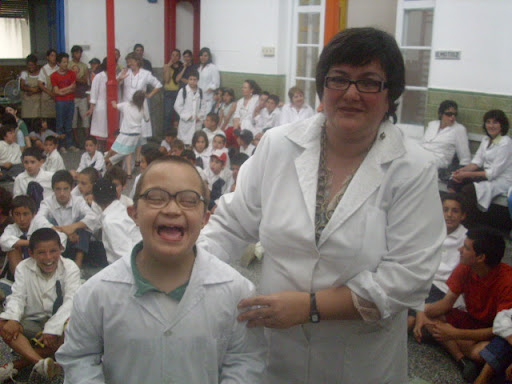
Image 2: We were giving the first XOs to the kids in the school for disabilities. One of the volunteers stuck the labels and scanned the laptops; we called out the kids one by one to receive their laptop. We called for 'Juan'; the principal, with a big smile, said to us: "you'll see". From behind a steel column, in the roofed patio of the old house, emerged a little kid with big cheeks and glasses, tumbling around with a great big smile. Juan has Down's Syndrome. He's happy and you see it. Everybody can tell. He received his laptop and quickly and happily tumbled back to his place. Everybody cheered. It was a party!


Thank You Cesar!

More pictures:

Inside One Laptop per Child: Episode 4

Originally published by Pablo Flores on Sat, Dec 22nd, 2007
Translated by Paul D. Spradling

Episode 04 takes us on location in Porto Alegre, Brazil. Where the first batches of XOs have been delivered and deployed. Meet the teachers using the laptops in the classroom. Where besides doing daily assignments on the machines, some students have already learned programing. Local culture has permeated the project, and as a veteran school principal explains, an improved education is set to equip a new generation of Brazilian citizens.


It's strange that OLPC is using Brazil as an example, given the recent news of brazil's apparent loss in an auction to purchase 150,000 computers for children.
The auction went to Grupo Positivo with a new version of the Classmate PC.

Inside One Laptop per Child: Episode 3

Originally published by enrique_place on Tue, Jun 19th, 2007
Translated by Paul D. Spradling

How can these laptops "talk" to each other even without widespread internet access? How is the network they create different from the network at your home or office? Episode 03 explains it all.

Source: OLPC.tv

Inside One Laptop per Child: Episode 2

Originally published by enrique_place on Tue, Apr 24th, 1007
Translated by Paul D. Spradling

Episode 02 of this series produced by Red Hat documenting the One Laptop per Child project focuses on the activities built for the laptop.


I love the minimalist offices with the walls covered in white-boards! ;-)

The following video is from Eduardo Silva's blog (Chile). Eduardo contributes to the OLPC project thru Google.

Inside One Laptop per Child: Episode 1

Originally published by enrique_place on Wed, Apr 25th, 2007.
Translated by Paul D. Spradling

First part of a video produced by Red Hat.
Red Hat has a close relationship with this project: they collaborate with developers and investigation; and a version one of their products: Fedora Core GNU/Linux, is included in the laptops.

"This is the story of the little green laptop that could. Meet the faces behind the One Laptop per Child initiative and see what they do every day in the Cambridge, MA office. Sit in on a brainstorming session. And find out what you can do to help."


"The famous" Marcelo Tossati (brasilian), can be seen participating in the project near the end of the video. He has worked in Conectiva (now Mandriva), and has been put in charge of maintaining a branch of the GNU/Linux kernel by the one and only Linus Torvalds.

Activities supporting Ceibal Project begin in Sarandí Grande

Originally published by Pablo Flores on December 14th, 2007. Translated by Paul D. Spradling.

Project "Flor de Ceibo", initiated in the Universidad de la Republica, has given rise to the collaboration between Plan Ceibal and LATU (Uruguay's Technological Laboratory). The project's general aim is to organize volunteer activities, counting with the participation of students and staff of the university. The project is in an embryonic state, but its aims are well defined:

The university will support Project Ceibal, accompanying and contributing, with the end of improving opportunity and equality in the access to the new technologies to all children in the country; generating a profound change in education.

It is expected that students and staff of the university will participate, contributing their experience to facilitate the students, teachers and parents first encounter with this new tool (the laptop).

By means of an activity of mass participation throughout the university, it is expected to contribute essential elements to the formation of the university's students. Key elements include: closer contact with the reality of the country, development of communication and expression skills, and the horizontal link with students and staff of other faculties or mayors.

We hope to generate links that will potentially give birth to projects of development, content or that will contribute national know-how. It is expected from this experience, that some students will maintain contact with the schools that they visited and that development projects with social utility will surface.

We aspire for a project of mass participation by students and staff of a variety of carriers, which will develop throughout the year 2008 in which Project Ceibal will spread throughout all rural areas of the country.

The modality of uniting, in mass, the university's students to the volunteer activities of Plan Ceibal will begin next year. Nevertheless, a preliminary activity in which only professors will participate, is already planned.

It will take place in the Sarandí Grande Theatre this following Wednesday, December 19th. The work schedule is the following:

10:00 to 10:30 Meet with teachers: Introduction.

10:30 to 12:30 Meet with teachers: Laptop utilization and email workshop. Q&A.

13:30 to 14:00 Meet with parents: Introduction.

14:00 to 16:00 Meet with parents: Laptop utilization and email workshop. Q&A.


The idea is to back off a little from exclusive school use, and to support the families so that they also take advantage of this powerful resource.

We expect everyone in the region. It is recommended to bring your own laptop.

On Students' Motivation


Based on a question in an earlier post, I'm making some comments on the project's influence on students' motivation.

Motivation is hard to measure quantitatively. According to the headmaster at the Cardal school, there was never any problem with desertion or any high level of absenteeism, but the latter was reduced this year (i.e., the kids were absent less than in other years). The teachers also tell us that students seem more motivated and that, in particular, they enjoy it when it's time to work with laptops.

On the other hand, additional motivation comes up when the kids take their computers home and show their parents what they have done and what they have created. In this sense, there's generalized perception that the project is helping to bring families "closer" to the school. Edith Moraes, director of the grade school, says that she's very happy that a long-existing trend is reversing itself - where it seemed that the school was going down one path and families down another.

In any case, these results are extremely preliminary given that the Cardal experience has special qualities due to it's enormous level of exposure.

We could have a new reference point in the next few days, when massive laptop distribution begins in other schools in Florida.

PS: I'll soon be adding some videos to this post.

"Special Report: Uruguay, the next Finland of Latin America"

Translated from "Reporte Especial: Uruguay la futura Finlandia de América Latina"


That's the title of the article published on the site Un computador por niño - Chile, in which there is a very good revission of the Ceibal Project and its strategical goals.

It includes an interview made by Luis Ramírez to Sylvia González, project coordinator. It's been subtitled into English through the fav2fav blog, here it goes...

Today begins the mass production of XO laptops

According to what Walter Bender said today in the inauguration of the OLPC Learning Workshop that is being held this week in Boston, right in this moment is starting the mass production of XO laptops. Initially, it is expected to have a production of 15.000 laptops per week, which will be accelerated afterwards.